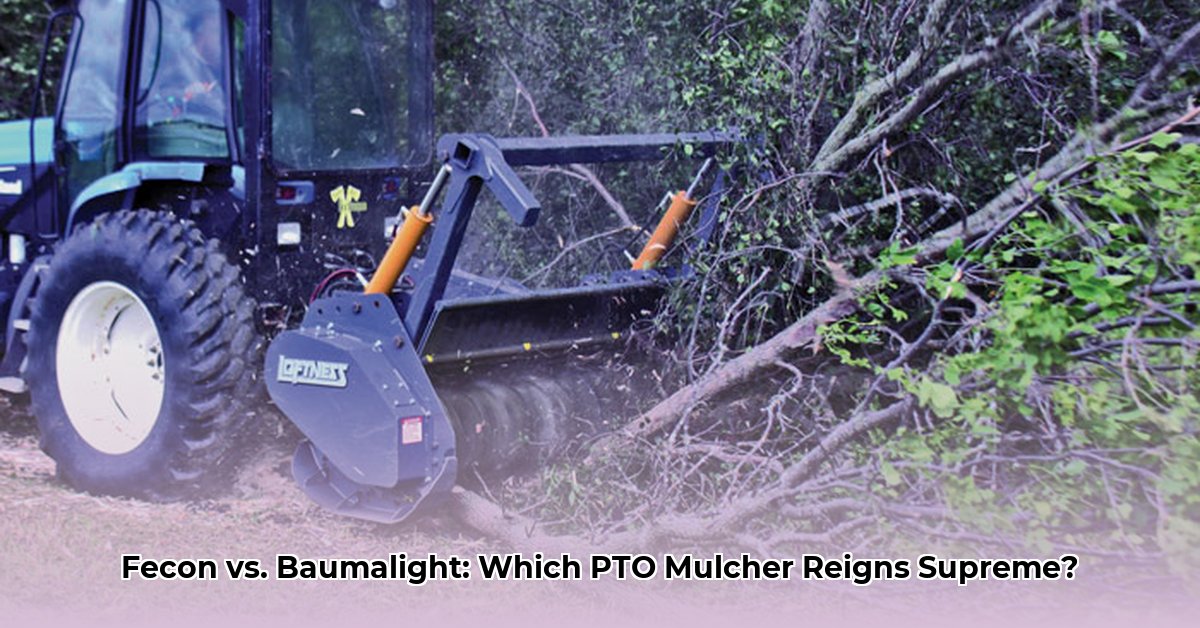
Choosing the right PTO (Power Take-Off) driven brush mulcher is a crucial decision for farmers and land managers. This comparative review analyzes two leading contenders: the Fecon Bull Hog and the Baumalight MP360, highlighting their strengths and weaknesses to help you make an informed purchase. For more information on PTO driven mulchers, see this helpful resource.
Cutting Mechanisms: A Tale of Two Approaches
The Fecon Bull Hog and Baumalight MP360 employ vastly different cutting systems. The Fecon Bull Hog uses a rotating drum studded with sharp blades, ideal for aggressive clearing of dense brush and small trees. Think of it as a powerful wood chipper designed for large-scale land clearing. Its aggressive action makes quick work of tough vegetation.
Conversely, the Baumalight MP360 utilizes a series of fixed, replaceable teeth. This provides a more refined, less aggressive cut, making it suitable for maintaining neat edges and handling lighter brush. Imagine it as a larger, more powerful version of hedge trimmers, perfect for precise landscaping and perimeter maintenance. The choice hinges on your specific needs: aggressive clearing or refined trimming?
Power Requirements: Matching Mulcher to Tractor
The Fecon Bull Hog demands a powerful tractor due to its heavy-duty design. It requires substantial horsepower for optimal performance, making it unsuitable for smaller tractors. Matching the tractor's capabilities to the mulcher's demands is essential for productive and safe operation. Underpowering the Bull Hog will severely hamper its functionality.
The Baumalight MP360, being lighter and less demanding, is compatible with smaller, less powerful tractors. This makes it an accessible option for farmers with smaller operations or less powerful equipment. This versatility adds to its appeal for those with more limited resources.
Long-Term Costs: Maintenance and Durability
Both mulchers are built for longevity, but maintenance differs significantly. The Baumalight MP360's replaceable teeth allow for easier and potentially cheaper maintenance—replacing individual teeth is simpler than replacing entire blade assemblies on the Fecon Bull Hog. This cost-effectiveness could translate into long-term savings.
While both are durable, the Fecon Bull Hog's more complex design might lead to higher repair costs when major components need replacing. The Baumalight's simpler design potentially translates to greater operational efficiency over its lifespan.
Key Features Compared: A Side-by-Side Look
The following table summarizes the key differences between the Fecon Bull Hog and the Baumalight MP360:
| Feature | Fecon Bull Hog | Baumalight MP360 |
|---|---|---|
| Cutting System | Rotating drum with blades | Fixed, replaceable teeth |
| Working Width | Typically wider, higher capacity per pass | Typically narrower, higher precision |
| Horsepower Requirement | High; requires a powerful tractor | Lower; compatible with smaller tractors |
| Best Applications | Aggressive land clearing, dense vegetation | Light brush management, perimeter maintenance |
| Maintenance | More complex; higher potential repair costs | Simpler; lower potential repair costs |
| Typical Initial Cost | Higher upfront investment | Generally lower initial cost |
Choosing the Right Mulcher: Considering Your Operation
The "best" mulcher depends entirely on your specific needs. The Fecon Bull Hog excels in aggressive land clearing, handling dense vegetation and small trees with ease. Its high capacity makes it ideal for large-scale projects.
Conversely, the Baumalight MP360 is a more cost-effective and manageable choice for smaller operations and lighter vegetation. Its precise cutting and compatibility with smaller tractors make it attractive to those with more limited resources. Consider the scale of your operation, the type of vegetation you'll be clearing, and your tractor's capabilities before making a decision.
Sustainable Practices: Beyond the Equipment
Regardless of your chosen mulcher, sustainable practices are critical. Regular maintenance, as highlighted by John Deere's (largest agricultural machinery manufacturer) research, significantly extends equipment lifespan and reduces environmental impact. Proper operator training is equally important for safety and efficient operation. Considering these factors will improve overall operational efficiency and respect for the environment.
Key Takeaways:
- Consider the density of the vegetation you'll be mulching (dense vs. light).
- Assess your tractor's horsepower capabilities to ensure compatibility.
- Factor in both initial cost and long-term maintenance expenses. (Research shows that preventative maintenance can reduce long-term costs by up to 30%.)
- Prioritize safety features – both in the mulcher's design and operator training.
This comprehensive comparison provides a solid foundation for making an informed decision. Carefully weigh the pros and cons of each mulcher, considering your unique needs and budget, to ensure you select the optimal tool for your operation.